 By Saurav Mehra
 Petrol prices in India have made every car buyer more serious about mileage. Earlier, people casually asked, “Kitna deti hai?” Today, that question decides the EMI comfort, monthly budget and even the final car choice. A family driving daily through Bengaluru traffic, a Delhi-NCR office commuter, a Pune IT professional, a Mumbai suburban driver or a highway user between Lucknow and Kanpur—all want lower fuel bills without giving up convenience.
This is where hybrid cars enter the discussion. But the word “hybrid” itself creates confusion. One car says mild hybrid. Another says strong hybrid. A salesperson may say both save fuel. Online brochures show impressive mileage figures. YouTube reviews show different real-world numbers. So the practical question is: which one actually saves more petrol—strong hybrid or mild hybrid?
The simple answer is that strong hybrids usually save much more fuel, especially in city traffic. Mild hybrids give smaller savings and mainly support the petrol engine. But strong hybrids are costlier to buy. So the real decision is not only about mileage; it is about your monthly running, city usage, highway driving, budget and how long you plan to keep the car.
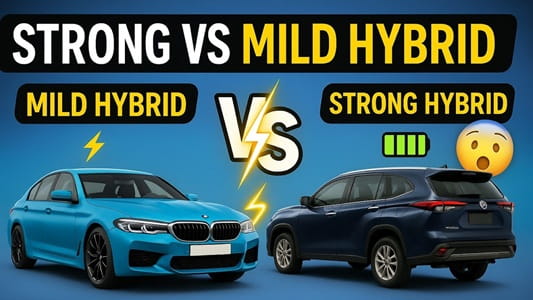
What Is a Mild Hybrid Car?
A mild hybrid car has a small battery and a small electric motor or starter-generator that assists the petrol engine. It cannot drive the car on electric power alone. The engine remains the main source of movement.
In simple words, mild hybrid technology helps the engine work a little more efficiently. It may support smoother start-stop operation, provide slight torque assistance during acceleration and recover some energy during braking.
Many Indian buyers have seen this technology in cars marketed as smart hybrid, mild hybrid or SHVS-type systems. It is useful, but it is not a full electric-driving system.
A mild hybrid is like a helper standing beside the petrol engine. It supports, but it does not take over the job.
What Is a Strong Hybrid Car?
A strong hybrid, also called a full hybrid, has a larger battery, stronger electric motor and more advanced hybrid system. It can move the car on electric power alone for short periods, especially at low speeds or in traffic.
In a strong hybrid, the petrol engine and electric motor work together intelligently. Sometimes the car runs on battery power. Sometimes the petrol engine runs. Sometimes both work together. During braking, the system recovers energy and charges the battery.
You do not need to plug in a strong hybrid. The battery charges automatically through the engine and regenerative braking.
In Indian city traffic, where cars frequently stop, crawl, brake and move slowly, this system can save a lot of fuel.
The Main Difference in Real Driving
The biggest difference is this: a mild hybrid assists the engine, while a strong hybrid can reduce engine running time.
In a mild hybrid, the petrol engine does most of the work. The electric system gives small support. So fuel savings are limited.
In a strong hybrid, the car can switch off the petrol engine more often and use electric power at low speeds. Since city driving has many low-speed sections, strong hybrids can deliver much better mileage.
This is why strong hybrids shine in stop-go traffic, while mild hybrids give only moderate improvement.
Real Fuel Savings: What to Expect
In practical terms, a mild hybrid may improve fuel efficiency slightly compared to a normal petrol car. The saving can be useful, but it is usually not dramatic. Depending on driving style and model, the difference may feel like a small bonus.
A strong hybrid can deliver much bigger savings, especially in city use. In many Indian strong hybrid cars, claimed mileage figures are much higher than regular petrol versions. Real-world mileage may be lower than claimed figures, but the gap still remains meaningful for many users.
For example, if a normal petrol automatic SUV gives around 12–14 km/l in city traffic, a strong hybrid version may deliver around 18–24 km/l depending on route, traffic, driving style and AC use. A mild hybrid version of the same type may improve mileage slightly, but it usually will not match the strong hybrid.
Why Strong Hybrids Save More Fuel in Cities
City traffic is the perfect playground for strong hybrids. In traffic jams, signals, parking areas, society roads and slow-moving office routes, the electric motor can handle low-speed movement more efficiently.
Every time you brake, the hybrid system captures some energy that would otherwise be wasted as heat. This energy goes back into the battery and helps the car move later.
The petrol engine also gets switched off more often when not needed. This reduces idle fuel waste at signals and in bumper-to-bumper traffic.
This is why a strong hybrid can feel surprisingly efficient in cities where normal petrol cars drink fuel quickly.
Why Mild Hybrids Save Less
Mild hybrids have smaller batteries and weaker electric support. They cannot run the car independently on battery power. This limits their fuel-saving ability.
They help during engine restart, acceleration support and braking energy recovery, but the benefit is smaller. In heavy traffic, a mild hybrid may still burn fuel because the engine remains the main driver.
Mild hybrids are useful because they are simpler and cheaper than strong hybrids. They offer better efficiency than basic petrol cars in some cases, but they are not designed to deliver strong-hybrid-level savings.
Highway Mileage: The Gap Becomes Smaller
Strong hybrids are most efficient in city conditions. On highways, the petrol engine runs more continuously because speeds are higher and braking is less frequent.
This does not mean strong hybrids are bad on highways. They can still be efficient because the engine is tuned for economy. But the advantage over mild hybrids may reduce compared to city driving.
If you drive mostly on open highways at steady speeds, a mild hybrid or efficient petrol car may perform reasonably well. If you drive mostly in city traffic, the strong hybrid advantage becomes much clearer.
Purchase Price Difference
Strong hybrid cars are usually more expensive than mild hybrid cars. The extra cost comes from the larger battery, electric motor, power electronics and advanced hybrid system.
This higher price is the biggest reason buyers hesitate. A strong hybrid may save fuel every month, but you need enough running to recover the extra cost.
If your daily running is high, the fuel savings can justify the premium over time. If you drive only 500–700 km a month, the savings may not be enough to recover the extra price quickly.
So, do not buy a strong hybrid only because the mileage figure looks attractive. Calculate your real monthly usage.
Simple Fuel Cost Comparison
Let us take a practical example.
Suppose petrol costs around ₹100 per litre. A mild hybrid car gives 15 km/l in your usage. A strong hybrid gives 22 km/l.
If you drive 1,500 km per month, the mild hybrid will use around 100 litres of petrol. Monthly fuel cost will be about ₹10,000.
The strong hybrid will use around 68 litres. Monthly fuel cost will be about ₹6,800.
That is a saving of around ₹3,200 per month, or around ₹38,000 per year.
If the strong hybrid costs ₹2 lakh more, it may take around five years to recover the extra cost through fuel savings in this example. If your running is higher, recovery is faster. If your running is lower, recovery is slower.
Maintenance and Reliability
Many people worry that strong hybrids are complicated and expensive to maintain. In reality, modern strong hybrid systems are designed for long-term use, but they still have more components than a mild hybrid.
Mild hybrids are simpler and may be cheaper to maintain because the system is less complex. Strong hybrids need proper service from trained technicians and brand-authorised centres.
Battery warranty is an important factor. Before buying a strong hybrid, check hybrid battery warranty, replacement terms, service network and long-term ownership support.
Do not skip scheduled service. Hybrid systems work best when maintained properly.
Battery Replacement Fear
Strong hybrid batteries are not like mobile phone batteries that fail quickly after two or three years. They are designed for automotive use and usually come with long warranties.
Still, replacement cost can be high if battery failure happens outside warranty. This is why brand reliability, warranty coverage and service network matter.
For buyers in metro cities and large towns, strong hybrid service support is usually easier. For smaller towns, check nearby service availability before booking.
Driving Style Affects Savings
Hybrid mileage depends heavily on driving style. Smooth driving gives better results. Harsh acceleration, sudden braking, high-speed driving and constant aggressive overtaking reduce fuel savings.
Strong hybrids reward calm driving. If you accelerate gently, use regenerative braking naturally and avoid unnecessary high speeds, mileage improves.
Mild hybrids also benefit from smooth driving, but the improvement is smaller.
If you drive aggressively all the time, do not expect brochure-level mileage from any hybrid.
AC Use and Indian Weather
Indian weather affects fuel efficiency. Heavy AC use in summer, traffic jams, full passenger load and hilly roads can reduce mileage.
Strong hybrids may still handle city AC load better than normal petrol cars, but mileage will drop compared to ideal conditions.
In cities like Delhi, Ahmedabad, Jaipur, Hyderabad and Nagpur, summer AC use is high. So real-world mileage should always be judged with AC on, not in perfect test conditions.
Which Is Better for City Drivers?
For city drivers with high monthly running, a strong hybrid is usually the better fuel-saving choice. If you face daily traffic, signals, slow movement and office commutes, strong hybrid technology can save serious petrol.
This is especially useful for automatic car buyers because petrol automatics often have lower city mileage. Strong hybrids can make automatic driving more fuel-efficient.
If your budget allows and your running is high, strong hybrid makes strong practical sense.
Which Is Better for Highway Users?
If your driving is mostly highway-based, the advantage of strong hybrid reduces. A mild hybrid or efficient petrol car may be enough if it offers good highway mileage and costs less.
Highway users should also consider comfort, stability, boot space, safety rating, service network and engine performance.
For mixed city-highway users, strong hybrid can still be useful if city running is significant.
Which Is Better for Low-Running Buyers?
If you drive less than 700–800 km per month, a mild hybrid or normal petrol car may be more sensible. The extra cost of a strong hybrid may take too long to recover.
For low-running buyers, purchase price, maintenance cost, insurance, resale value and comfort may matter more than maximum mileage.
A strong hybrid is best when fuel savings are actually used regularly.
Resale Value
Strong hybrids may have good resale appeal as fuel prices rise and buyers become more mileage-conscious. However, resale also depends on brand, battery warranty, service history and market trust.
Mild hybrids are easier for many second-hand buyers to understand because they are closer to regular petrol cars.
Keep service records properly if you own a strong hybrid. A well-maintained hybrid with battery warranty can attract better buyer confidence.
Strong Hybrid vs Mild Hybrid: Practical Choice
Choose a strong hybrid if your monthly running is high, most driving is in city traffic, you want an automatic, petrol prices worry you, and you plan to keep the car for several years.
Choose a mild hybrid if your budget is tighter, running is moderate, highway use is higher, you want simpler technology, and you do not want to pay a large premium upfront.
Both technologies have value, but they are not equal in fuel savings. Strong hybrid saves more. Mild hybrid costs less.
FAQs
Q1. Does a strong hybrid save more fuel than a mild hybrid?
Yes, a strong hybrid usually saves much more fuel, especially in city traffic. It can run on electric power for short periods and switch off the engine more often, while a mild hybrid only assists the petrol engine.
Q2. Is a mild hybrid worth buying?
A mild hybrid is worth buying if you want slightly better fuel efficiency without paying a big premium. It is simpler and cheaper than a strong hybrid, but fuel savings are smaller.
Q3. Is a strong hybrid good for highway driving?
A strong hybrid can be efficient on highways, but its biggest advantage is in city traffic. On highways, the fuel-saving gap between strong hybrid and mild hybrid may become smaller.
Q4. How much monthly running is needed to justify a strong hybrid?
A strong hybrid makes more financial sense if you drive around 1,200–1,500 km or more per month, especially in city traffic. If your running is low, the extra purchase price may take many years to recover.