 By Saurav Mehra
 Every year, thousands of young people leave their villages chasing city jobs, convinced that real money only exists beyond the highway that connects their town to the nearest metro. Meanwhile, someone back home quietly builds a dairy supply business, a mobile repair counter, or a small poultry unit and ends up earning more than a fresh graduate’s starting salary in Bangalore, without ever leaving home. Rural India isn’t the limited, low-opportunity space it used to be, better roads, growing internet access, and stronger government support have genuinely changed what’s possible.
With over 65% of India’s population still living in rural areas, and government schemes like PMEGP, MUDRA loans, and NABARD-backed programs actively funding small entrepreneurs, the barriers that once made starting a village business feel risky have genuinely come down. Here are ten businesses that consistently deliver strong returns on relatively modest starting capital, the kind of ventures your neighbours, cousins, or you yourself could realistically start this year.
1. Dairy Farming
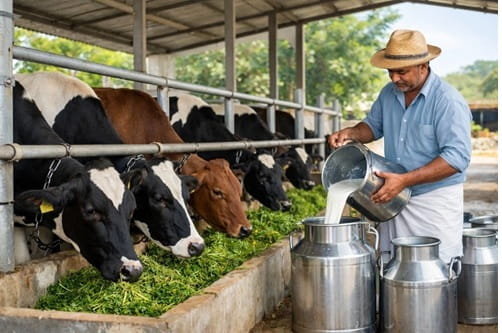
This remains one of the most dependable village businesses precisely because demand never pauses, everyone needs milk, curd, and paneer every single day, regardless of season or economic mood. Starting with just a few cows or buffaloes, most entrepreneurs begin generating steady monthly income within a few months, selling to local households, sweet shops, or established collection networks like Amul that actively source milk from rural areas.
A small-scale dairy unit typically needs somewhere between ₹1 lakh and ₹5 lakh to get started, covering animals, basic housing, and feed. Monthly profit potential genuinely ranges from ₹30,000 to over ₹1 lakh depending on your herd size and how many animals you’re milking. Moving beyond raw milk into value-added products like ghee or paneer pushes your margins considerably higher once you’ve established a reliable customer base.
2. Poultry Farming
Chicken and eggs enjoy consistently high demand across both rural and urban markets, and poultry farming offers something dairy doesn’t, considerably faster returns since birds mature and start producing within weeks rather than months. You can genuinely start small, a few hundred birds in a basic enclosure, and scale gradually as your customer relationships with local hotels and markets strengthen.
Initial investment for a modest poultry setup typically runs lower than dairy, often starting around ₹50,000 to ₹1 lakh for housing, chicks, and feed. Monthly profit potential ranges from ₹40,000 to over ₹1 lakh depending on scale, though maintaining strict hygiene and biosecurity protocols matters enormously here, since disease outbreaks can wipe out an entire flock if you’re careless about basic precautions.
3. Mobile Repair Shop
With smartphones now genuinely essential even in the smallest villages, repair demand consistently outpaces the number of technicians available in most rural areas. After completing a short repair technician course, widely available through ITI centres and private training academies, you can start from a small counter offering screen replacements, battery swaps, and basic software troubleshooting.
This business needs surprisingly little upfront capital, roughly ₹50,000 to ₹80,000 covers your shop space, repair toolkit, and initial accessories stock. Labour on repairs carries close to 100% margin since your primary cost is simply your time and skill, while reselling accessories and spare parts adds another steady revenue stream with margins around 40%.
4. Organic Vegetable and Grain Farming
Health-conscious buyers in cities are increasingly willing to pay a genuine premium for chemical-free produce, and India’s organic food industry is projected to grow considerably over the next several years. If you already have access to land, which most rural entrepreneurs do, this is genuinely one of the lowest-barrier businesses on this list since your core resource is already available.
Starting costs typically range from ₹10,000 to ₹50,000 for quality seeds, natural manure, and basic tools. Selling through local mandis works fine initially, but connecting with restaurants directly or through agricultural aggregator apps like DeHaat and Ninjacart can meaningfully improve your per-unit price once you’ve built a reliable harvest cycle.
5. Fertiliser and Seed Shop
Farmers need seeds, fertilisers, and pesticides every single growing season, making this genuinely one of the most stable, repeat-customer businesses available in agricultural regions. Stocking recognised brands like IFFCO gives your shop credibility from day one, and once farmers trust your supply quality, they tend to return season after season without needing to be convinced twice.
This business typically needs a moderate investment, often ₹1 lakh to ₹2 lakh for initial inventory and basic storage, with monthly profit potential ranging from ₹40,000 to ₹1.5 lakh depending on how many farming households your shop actually serves.
6. Traditional Handicrafts
India’s handicraft sector genuinely functions as a global export powerhouse, and rural artisans skilled in pottery, bamboo work, jute weaving, or terracotta craft carry an inherited skill that costs nothing extra to train for. What’s changed considerably in recent years is distribution, platforms like Amazon Karigar, Meesho, and the government’s GeM portal now let rural craftspeople reach customers far beyond their immediate area without needing a physical retail presence elsewhere.
Starting capital here is genuinely minimal, often just ₹5,000 to ₹30,000 for raw materials and basic packaging. The real determinant of profitability isn’t the craft itself, since the skill is already there, it’s connecting with the right online buyer or aggregator and investing a bit in genuinely attractive packaging and photography that helps your product compete online.
7. Papad, Pickle, and Snack Making
This conventional business carries genuinely significant potential when approached professionally rather than as a purely informal, small-batch operation. The trick in 2026 is differentiation, rather than just selling generic papad locally, emphasise distinct flavours like garlic, chilli, or ragi, and lean into “handmade” and “sun-dried” as genuine selling points that resonate with health-conscious urban buyers.
This is also one of the most accessible businesses for rural women specifically, since you can hire local women and build a small production operation right in your own backyard. Starting investment runs remarkably low, often just ₹10,000 to ₹25,000 for basic equipment like a rolling pin, drying mats, and a packaging sealer, with the flexibility to scale production up as demand grows.
8. Tailoring and Stitching Services
For anyone skilled in stitching, embroidery, or weaving, this remains one of the most accessible village businesses precisely because it needs minimal equipment beyond a sewing machine and genuinely relies on skill you likely already have. Many rural women have successfully built this into a stable, scalable business, often supported through self-help group programmes and rural livelihood schemes specifically designed to fund exactly this kind of skill-based enterprise.
Investment here typically runs ₹15,000 to ₹40,000 covering your machine and initial supplies, with profit margins genuinely strong, often 70 to 85%, since your primary cost beyond the initial equipment is simply your own time and expertise.
9. Rural Retail and Grocery Shop
Every village needs consistent access to groceries, toiletries, and daily household essentials, and rural customers genuinely prefer buying locally rather than travelling to the nearest town for basic necessities. This makes retail one of the most dependable, recession-resistant businesses on this entire list, since demand for daily essentials simply never disappears regardless of broader economic conditions.
You can genuinely start this business with as little as ₹50,000, covering initial inventory across groceries, medicines, or household essentials, and it grows organically as your customer base becomes more loyal and your product range expands based on what people actually keep asking for.
10. Solar Energy Services
Power shortages and blackouts remain genuine problems across large stretches of rural India, creating real, ongoing demand for solar panel installation, solar water pumps, and solar lanterns. This business genuinely combines profitability with meaningful community impact, since you’re solving a real, persistent infrastructure gap rather than just selling another discretionary product.
Entry costs vary depending on whether you’re installing systems yourself or acting as a dealer for established solar brands, but this sector is expected to keep growing steadily as rural electrification gaps persist and government incentives for renewable energy adoption continue expanding.
Frequently Asked Questions
Q1. Which of these village businesses gives the fastest return on investment?
Mobile repair and papad or snack-making tend to generate income the quickest, often within the first month, since labour margins are high and you don’t need to wait through a full agricultural or livestock production cycle before earning your first profit.
Q2. Can I get government funding to start one of these businesses without using my own savings?
Yes, schemes like PMEGP, MUDRA loans, and NABARD-backed self-help group programmes specifically fund rural entrepreneurs, often with subsidised interest rates and minimal collateral requirements, making it genuinely possible to start several of these businesses without a large personal cash reserve.
Q3. Is it realistic for someone with no prior business experience to start a dairy or poultry farm successfully?
Yes, though starting small and scaling gradually matters considerably more here than in something like retail. Beginning with a handful of animals or a few hundred birds, learning the basics of hygiene and feeding schedules, and only expanding once you’ve stabilised your first cycle genuinely reduces your risk compared to jumping in at full scale immediately.
Q4. Which of these businesses works best for someone without much capital to start with, under ₹25,000?
Papad and snack-making, tailoring, and traditional handicrafts are genuinely the most accessible options in this range, since they rely primarily on existing skill and minimal equipment rather than large upfront inventory or livestock costs.